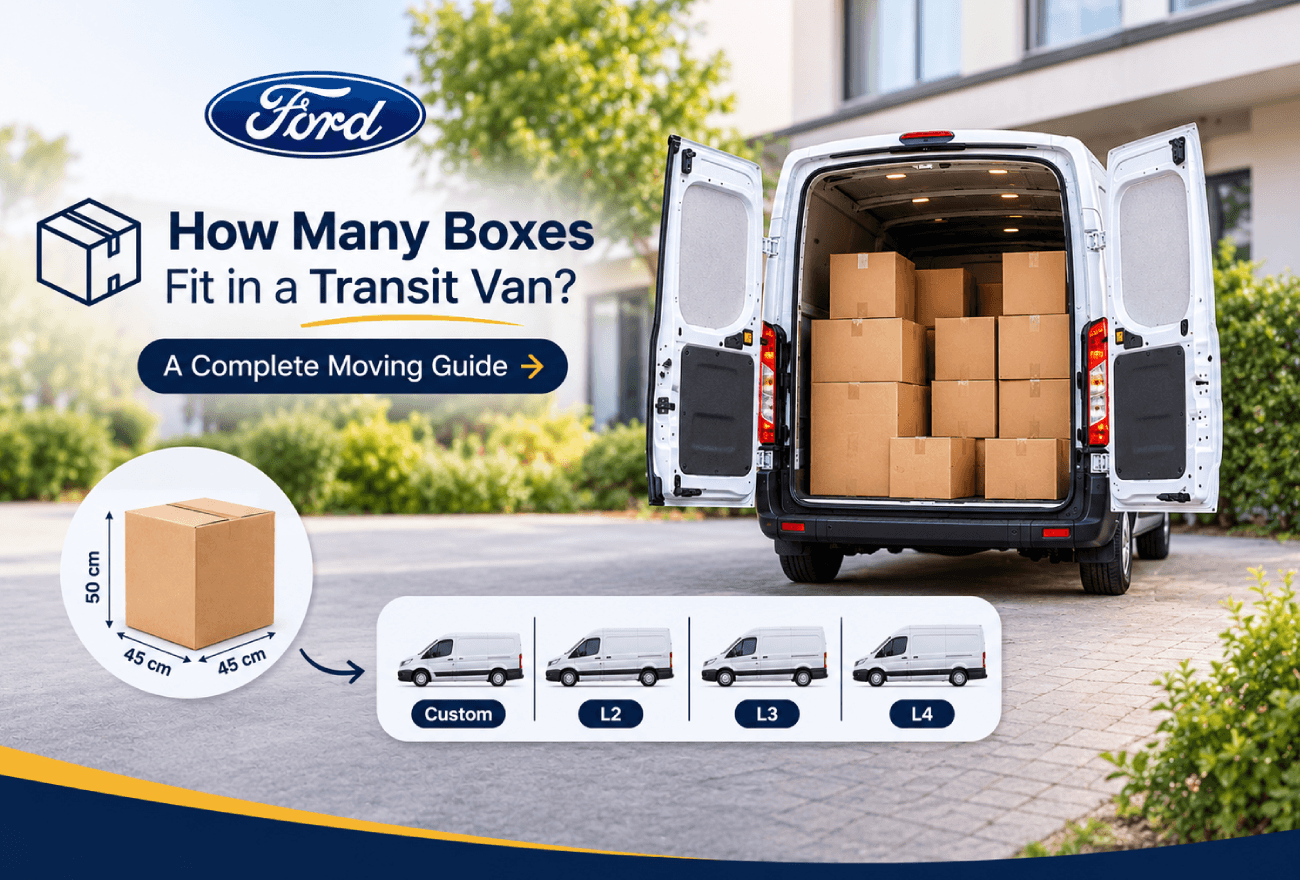
Whether you're moving house, transporting stock or collecting belongings from storage, knowing how many boxes fit in a Transit van can help you plan your journey and avoid unnecessary trips.
Ford Transit vans are among the most popular vehicles used for removals in the UK. However, not every Transit is the same size. A compact Transit Custom offers considerably less loading space than a long-wheelbase, high-roof Transit.
The number of boxes you can carry also depends on their dimensions, how they're stacked and whether you're transporting furniture alongside them.
In this guide, we'll explain how many boxes fit in a Transit van, compare different van sizes and share practical tips for making the most of the available space.
Key Takeaways
- A Ford Transit Custom has approximately 5.8–6.8 cubic metres of load space in standard panel-van configurations.
- Larger Ford Transit vans offer substantially more room, with certain configurations providing up to 15.1 cubic metres.
- A typical large removal box measuring 45 × 45 × 50 cm occupies approximately 0.10 cubic metres.
- As a rough planning estimate, a Transit Custom might accommodate around 30–45 large moving boxes, while larger Transit vans may accommodate approximately 50–95, depending on configuration and loading conditions.
- Smaller boxes can fit in greater numbers, but their combined weight may become the limiting factor.
- Furniture, wheel arches, loading equipment and the need to secure your belongings all reduce usable space.
- Measuring your boxes and checking the van's payload limit is more reliable than relying on a box count alone.
Quick Answer: How Many Boxes Can Fit in a Ford Transit?
A Ford Transit Custom can potentially carry around 30–45 large moving boxes, while a larger Ford Transit may accommodate approximately 50–95 large boxes.
These are illustrative planning ranges for boxes measuring approximately 45 × 45 × 50 cm, assuming only part of the manufacturer's stated cargo volume can be used efficiently.
They are not guaranteed loading capacities. The actual number can be higher or lower depending on the van, box dimensions, loading arrangement and weight restrictions.
For a more accurate estimate, you'll need to know which Transit model you're using.
Ford Transit Van Sizes Explained
The term "Transit van" is often used to describe several different Ford vehicles.
This can cause confusion when hiring a van for moving house because their load capacities vary significantly.
Ford Transit Custom
The Transit Custom is a medium-sized van commonly used by tradespeople, delivery drivers and people moving smaller quantities of belongings.
Ford's published specifications for the current Transit Custom include approximately:
- Short-wheelbase L1: 5.8 cubic metres.
- Long-wheelbase L2: 6.8 cubic metres.
These figures refer to standard panel-van configurations. Double-cab versions and other body styles may provide less cargo space.
A Transit Custom can be suitable for moving boxes, smaller furniture and belongings from a flat or individual room.
Ford Transit L2
The larger Ford Transit L2 offers more loading space than the Transit Custom.
Depending on the model year, roof height and drivetrain, its cargo volume can be approximately 9.5–11 cubic metres.
This makes it useful for transporting larger quantities of moving boxes alongside selected pieces of furniture.
Ford Transit L3
An L3 Transit provides a longer load area, making it suitable for larger moving jobs.
Depending on the configuration, its load volume may be around 11–13 cubic metres.
The additional length can be useful when transporting bulky furniture or larger quantities of boxes.
Ford Transit L4
The L4 is one of the largest standard Transit panel-van configurations.
Certain high-roof versions provide up to approximately 15.1 cubic metres of load space.
These vans are often better suited to larger removals and transporting substantial quantities of equipment.
However, maximum cargo volume doesn't necessarily mean the van can safely carry the equivalent weight in boxes.
How Many Moving Boxes Fit in Different Transit Vans?
The following table provides illustrative estimates based on large removal boxes measuring approximately 45 × 45 × 50 cm.
Each box occupies around 0.101 cubic metres.
The estimates assume approximately 55–65% of the stated load volume can be used for boxes. This is a planning allowance rather than a tested loading configuration.
|
Van type |
Approximate load volume |
Estimated large boxes |
|
Transit Custom L1 |
5.8 m³ |
30–37 |
|
Transit Custom L2 |
6.8 m³ |
37–43 |
|
Transit L2 |
9.5–11 m³ |
52–70 |
|
Transit L3 |
11–13 m³ |
60–83 |
|
Transit L4 |
Up to 15.1 m³ |
82–96 |
Important: These figures are rough estimates for planning purposes. Actual box capacity depends on usable floor dimensions, wheel arches, safe stacking height, load restraint and the van's maximum permitted payload.
Some configurations may accommodate more boxes when packed efficiently, while mixed loads containing furniture may accommodate considerably fewer.
How Does Moving Box Size Affect Capacity?
Not all moving boxes are the same size.
Smaller boxes are generally used for heavy belongings such as books, while larger boxes are better suited to lighter items such as clothing, bedding and household accessories.
Common UK removal-box dimensions include:
|
Box type |
Example dimensions |
Approximate volume |
|
Small/medium removal box |
45 × 30 × 30 cm |
0.041 m³ |
|
Large removal box |
45 × 45 × 50 cm |
0.101 m³ |
|
Tall removal box |
45 × 45 × 75 cm |
0.152 m³ |
These are examples rather than universal industry standards. Box dimensions vary between suppliers.
Small Moving Boxes
Small boxes are particularly useful for books, kitchenware, documents and other heavy belongings.
Because they occupy less space, more can fit into a Transit van.
However, a large number of heavy boxes could exceed the vehicle's payload limit before the loading area is full.
Medium Moving Boxes
Medium boxes offer a practical balance between capacity and ease of handling.
They're commonly used for everyday household belongings, including smaller appliances, toys and miscellaneous items.
Using boxes of similar dimensions can make stacking easier and help reduce wasted space.
Large Moving Boxes
Large removal boxes are useful for lighter, bulky belongings such as bedding, clothing and cushions.
They take up considerably more room than smaller boxes and can become unstable if overloaded.
Avoid filling large boxes with heavy books or other dense materials.
How to Calculate How Many Boxes Will Fit in Your Van
If you want a more accurate estimate, you can calculate the approximate volume of your boxes and compare it with the van's load capacity.
Step 1: Measure Your Moving Boxes
Measure each box's length, width and height in metres.
For example, a large moving box might measure:
- Length: 0.45 metres
- Width: 0.45 metres
- Height: 0.50 metres
Multiply the three measurements:
0.45 × 0.45 × 0.50 = 0.10125 cubic metres
This is the approximate external volume of one box.
Step 2: Find Your Van's Load Volume
Check the manufacturer's specifications or ask your van hire company for the exact model and configuration.
For example, a Transit Custom with 6.8 cubic metres of load space has substantially less capacity than a larger Transit with 11 cubic metres.
Step 3: Allow for Wasted Space
Dividing the van's total volume by the volume of one box gives a theoretical figure, but it doesn't account for real-world loading limitations.
Wheel arches, the shape of the load area and the need to secure boxes all affect capacity.
For a rough initial estimate, you might allow around 55–65% of the stated volume for boxes.
This is not a universal packing efficiency figure. Actual results depend on the dimensions and arrangement of the load.
Step 4: Check the Weight
Before loading, calculate the approximate combined weight of your boxes and any other belongings.
The vehicle's payload limit must not be exceeded.
Remember to account for occupants, accessories and other loads where applicable to the vehicle's specified payload.
If your boxes are particularly heavy, weight may be a more important restriction than volume.
How Many Boxes Fit in a Transit Van With Furniture?
If you're moving house, you probably won't be transporting boxes alone.
Beds, wardrobes, sofas, tables and other furniture can take up a substantial amount of the available loading space.
For example, a two-seater sofa might occupy a large section of the floor, making it difficult to stack boxes efficiently around it.
Likewise, a mattress may fit lengthways inside a van but restrict how other belongings can be arranged.
When planning a mixed load, list your largest furniture items first.
Consider their dimensions, weight and whether they can be safely dismantled.
Then estimate how much room remains for boxes.
Avoid assuming you can stack heavy boxes on upholstered furniture or fragile belongings.
Can You Fit the Contents of a One-Bedroom Flat in a Transit Van?
A larger Transit van may be suitable for moving the contents of some one-bedroom flats, depending on how much furniture and how many belongings are involved.
A minimally furnished flat containing a bed, small sofa, table and a modest number of boxes may require substantially less space than a fully furnished property.
A Transit Custom could be sufficient for a smaller move, but it may require multiple trips if bulky furniture is involved.
For a complete flat move, a larger Transit or Luton van may be more practical.
The best approach is to create an inventory and measure your largest items before booking a vehicle.
How Many Boxes Fit in a Short-Wheelbase Transit?
A short-wheelbase Transit Custom L1 has approximately 5.8 cubic metres of load space in the standard panel-van configuration.
Using the illustrative large-box planning method above, this equates to approximately 30–37 boxes.
Smaller boxes may fit in greater numbers, provided they can be stacked securely and the vehicle remains within its permitted payload.
Always check whether your hire company is referring to a Transit Custom or a larger Transit model, as the terminology can vary.
How Many Boxes Fit in a Long-Wheelbase Transit?
Long-wheelbase Transit vans provide additional loading length, making them useful for larger removals.
A Transit L4 can offer up to approximately 15.1 cubic metres of cargo volume in certain configurations.
Using the same illustrative planning assumptions, this could accommodate approximately 82–96 large moving boxes.
However, this should not be treated as a guaranteed capacity.
If you're carrying heavy boxes, the vehicle's payload may be reached well before the loading space is full.
8 Tips for Fitting More Boxes in a Transit Van
1. Use Similar-Sized Boxes
Boxes of similar dimensions are generally easier to stack.
They can help create stable rows and reduce awkward gaps between items.
2. Put Heavy Boxes at the Bottom
Heavy boxes should be positioned low down, with lighter belongings above them where safe.
Distribute weight appropriately across the loading area rather than concentrating everything at one end.
3. Use Strong Double-Walled Boxes
Good-quality removal boxes are less likely to collapse under normal stacking loads.
Choose boxes suitable for the weight of their contents and follow any stated stacking limits.
4. Dismantle Furniture Where Possible
Removing table legs, dismantling bed frames and separating modular furniture can make larger items easier to transport.
Keep screws and fittings in labelled bags.
5. Load Large Items First
Position bulky furniture carefully before filling the remaining spaces with boxes.
Make sure everything can be secured properly.
6. Avoid Overfilling Boxes
Overloaded boxes are difficult to lift and may split during transportation.
Use smaller boxes for heavier belongings.
7. Secure the Load
Use suitable straps and the van's designated load-securing points.
Loose boxes can shift during braking or cornering, creating a serious safety risk.
8. Keep Essential Items Accessible
Pack items you'll need immediately after moving in a clearly labelled box.
Avoid burying important documents, medication or everyday essentials beneath the rest of your belongings.
What If Everything Won't Fit in the Van?
Sometimes, even a larger Transit van isn't enough to move everything in one journey.
This is particularly common when downsizing, moving between properties or renovating a home.
If you have more belongings than your van can safely carry, consider whether making multiple trips, hiring a larger vehicle or using temporary storage would be the most practical option.
For items that don't need to move immediately, a storage unit can provide somewhere to keep boxes and furniture until you're ready to collect them.
Before choosing a unit, it's useful to calculate your storage space based on the volume of your belongings, the size of your furniture and how frequently you'll need access.
This can help you avoid renting a unit that's unnecessarily large or discovering that your belongings won't fit once you arrive.
Transit Van vs Luton Van: Which Is Better for Moving Boxes?
Both Transit and Luton vans can be useful for moving house, but they have different advantages.
A standard Transit panel van generally has a lower loading height and may be easier to manoeuvre than a larger box-bodied removal vehicle.
A Luton van typically features a large, box-shaped loading area, which can be useful when transporting bulky furniture and stacked boxes.
However, Luton van capacities vary considerably, so it's important to compare the actual specifications rather than assuming every Luton is larger than every Transit.
|
Feature |
Ford Transit panel van |
Luton van |
|
Loading area |
Shaped around the vehicle body and wheel arches |
Generally more rectangular |
|
Manoeuvrability |
Often easier than larger removal vehicles |
Can be more challenging in tight spaces |
|
Bulky furniture |
Depends on van size and door openings |
Often suitable for large furniture |
|
Box stacking |
Wheel arches and body shape affect arrangement |
Box-shaped area can simplify stacking |
|
Best suited to |
Small to larger moves depending on configuration |
Larger household moves and bulky loads |
Check payload limits, internal dimensions and loading access before deciding.
Common Mistakes When Loading a Transit Van
Poor planning can lead to damaged belongings, wasted space and potentially unsafe journeys.
Some of the most common mistakes include:
- Ignoring the van's payload limit: A van can be overloaded even when there's space left inside.
- Using boxes that are too large: Heavy items packed into oversized boxes can be difficult to lift safely.
- Failing to measure furniture: Large items may not fit through the rear or side doors.
- Stacking fragile boxes underneath heavy ones: This increases the risk of crushing and damage.
- Leaving boxes unsecured: Items may shift during transportation.
- Forgetting about wheel arches: The internal floor isn't a perfect rectangle.
- Assuming all Transit vans are identical: Different models have significantly different load capacities.
Taking measurements and preparing a loading plan can help avoid these problems.
Frequently Asked Questions
How many large boxes fit in a Transit Custom?
As a rough planning estimate, a standard Transit Custom panel van might accommodate approximately 30–45 large moving boxes measuring 45 × 45 × 50 cm, depending on the wheelbase and loading arrangement. The actual capacity may differ.
How many boxes fit in a long-wheelbase Transit?
A larger long-wheelbase Transit may accommodate approximately 80–95 large moving boxes under the illustrative assumptions used in this guide. The exact figure depends on the van's configuration, box dimensions and payload limit.
Can you fit 100 boxes in a Transit van?
It may be possible to fit 100 boxes in some larger Transit configurations, particularly if the boxes are relatively small. However, 100 large removal boxes may not fit safely or practically, and their combined weight must be considered.
What size Transit van do I need for moving house?
The right size depends on the number of boxes, the dimensions of your furniture and the total weight of your belongings. Smaller moves may suit a Transit Custom, while larger moves may require a long-wheelbase Transit, Luton van or multiple journeys.
How many cubic metres is a Ford Transit?
Ford Transit cargo volumes vary by model. Current Transit Custom panel vans offer approximately 5.8–6.8 cubic metres, while larger Transit panel vans can offer up to 15.1 cubic metres in certain configurations.
Can you stack moving boxes to the roof of a Transit?
Boxes can be stacked where it is safe to do so, but the stack must remain stable, respect box strength limits and be properly secured. Avoid placing heavy boxes on fragile items or stacking belongings in a way that could obstruct safe loading or unloading.
Is a Transit van big enough for a sofa and moving boxes?
Many Transit vans can accommodate a sofa and moving boxes, depending on the sofa's dimensions and the van's configuration. Measure the sofa and door openings before booking.
How do I calculate how many moving boxes I need?
Start by listing the rooms and belongings you intend to pack. Estimate the number of boxes needed for each room, taking account of heavier items requiring smaller boxes. Once you know the box dimensions and quantities, you can estimate the total volume for transportation.
Choosing the Right Transit Van for Your Boxes
The number of boxes that fit in a Transit van depends on much more than the vehicle's overall size.
Box dimensions, furniture, stacking arrangements and weight restrictions all influence how much you can safely transport.
A smaller Transit Custom may be suitable for a modest number of boxes or a small move, while larger Transit vans provide substantially more space for household belongings.
Before hiring a van, measure your boxes, create an inventory of larger items and check the exact vehicle specifications.
Planning ahead can help you choose the right van, protect your belongings and make moving day considerably easier.